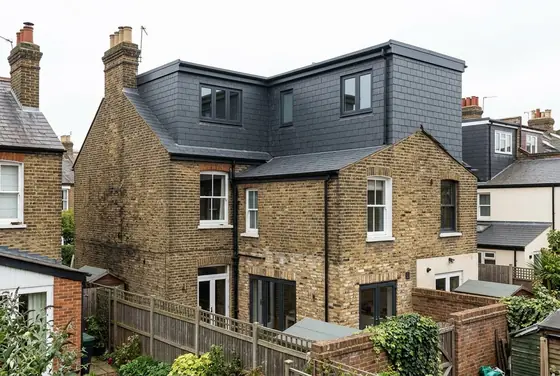
A rear dormer suits almost any house and costs £35,000 to £55,000. An L-shaped dormer only works on houses with a rear outrigger and costs £45,000 to £68,000, but usually adds a second room.
What is the difference?
A rear dormer is a single box on the back slope of the main roof. An L-shaped dormer adds a second box over the two-storey rear addition, joined to the first at the corner.
Which houses can have an L-shaped dormer?
Those with a two-storey outrigger: most Victorian and Edwardian terraces and some semis. Houses with a flat back wall cannot, and for them a full-width rear dormer or a hip-to-gable is the way to gain more space.
How much more space does the L give?
The outrigger dormer typically adds 6 to 10 square metres, enough for a bathroom or a small bedroom or study. On a short outrigger the gain can be too small to justify the cost.
Does the L-shape need planning permission?
Not necessarily. It can be permitted development, but the two dormers together must stay within 40 cubic metres on a terrace or 50 on a semi, and the outrigger dormer uses volume quickly.
Which is quicker to build?
A rear dormer usually takes 6 to 8 weeks on site, an L-shaped dormer 8 to 10. The L-shape also involves both neighbours on a mid-terrace, so allow time for party wall notices.
Our recommendation
If you need one bedroom and an en-suite, a rear dormer normally does it. If you need two rooms and your house has a long outrigger, the L-shape is usually the better investment.
Add us as a preferred source on Google